Diatomaceous Earth: The Good, The Bad & The Ugly
What it actually does in your garden, around your home, and on your farm — and the lung safety question, finally answered with real facts.
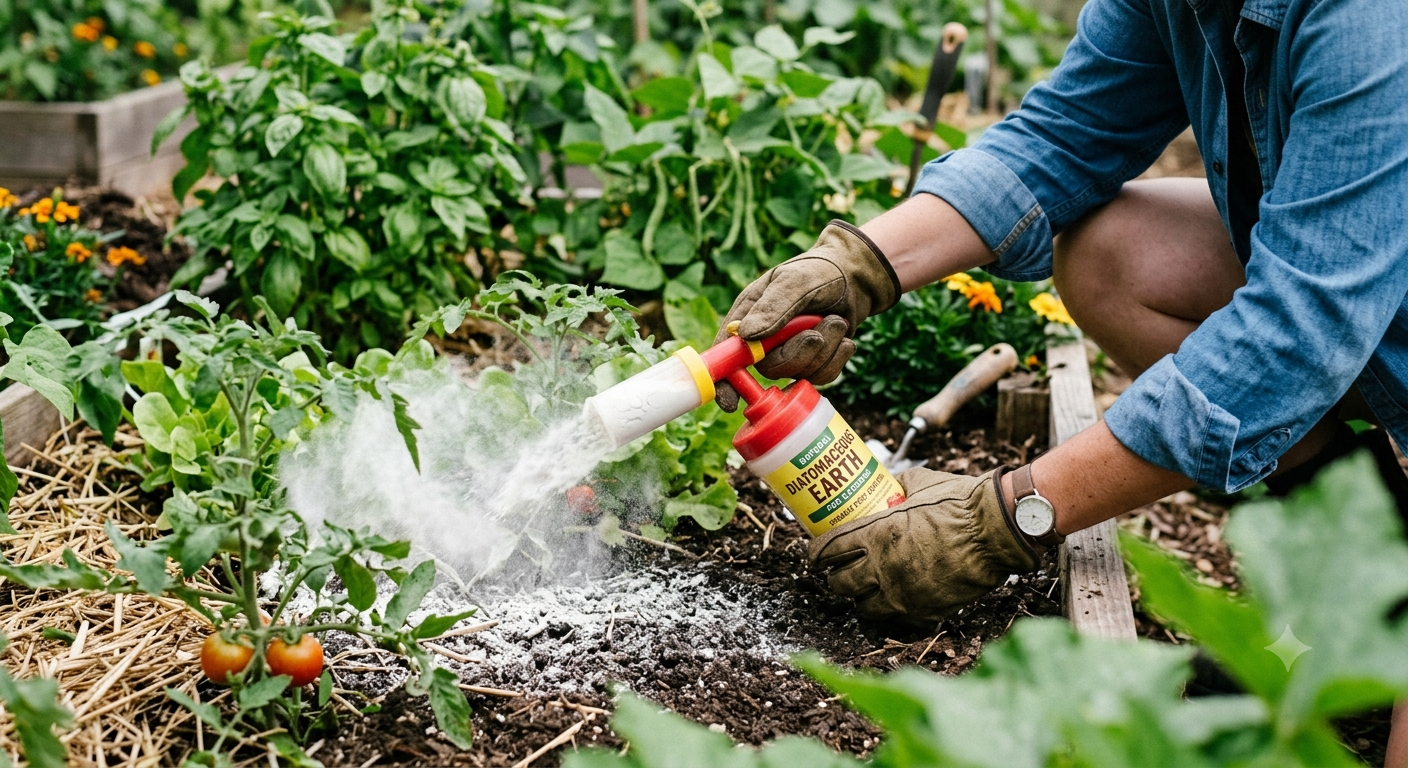
Diatomaceous earth — DE for short — shows up everywhere in homestead and natural-living circles. It's dusted on vegetable gardens, sprinkled around foundations, mixed into chicken feed, and recommended for everything from ant control to livestock deworming. It's also one of the most misunderstood products in natural pest control, with strong opinions flying in both directions: some people treat it as a miracle powder, others are convinced it'll wreck your lungs.
The truth is more useful than either extreme. DE genuinely works, has real limitations, and the safety question actually has a clear, evidence-based answer — it just depends entirely on which grade you're using. Let's go through it properly.
What DE Actually Is — and How It Works
Diatomaceous earth is made from the fossilized remains of diatoms — microscopic, hard-shelled algae that lived in ancient lakes and oceans. Those shells are composed largely of silica, and when ground into a fine powder, they take on a structure that looks smooth to us but is razor-sharp and jagged at a microscopic level.
DE doesn't poison insects. It kills mechanically: the sharp particles abrade the waxy outer layer of an insect's exoskeleton, and the powder absorbs the oils and fats in that layer. Without that protective coating, the insect loses moisture rapidly and dies of dehydration, typically within a day or two of contact. This is why DE works on ants, fleas, bed bugs, slugs, and countless other crawling pests — and also why it has no effect on anything until it physically touches the target.
Food Grade vs. Pool Grade — The Distinction That Actually Matters
This is the single most important thing to understand about DE, and it's where most of the confusion — and most of the legitimate danger — actually comes from. Not all diatomaceous earth is the same material once it's been processed.
| Food Grade DE | Pool / Filter Grade DE | |
|---|---|---|
| Processing | Minimally processed, not heat-treated | Calcined — heat-treated above 1,800°F |
| Crystalline silica content | Under 1–2% | Often 60% or higher |
| Primary form | Amorphous silica | Crystalline silica (cristobalite) |
| Safe for garden, home, animals? | Yes | No — never |
| Intended use | Pest control, feed additive, food storage | Swimming pool & industrial filtration only |
The calcination process used to make pool-grade DE converts the silica structure from amorphous (harmless) to crystalline — and crystalline silica is a genuinely well-documented respiratory hazard, linked to silicosis and lung disease with repeated inhalation. This is not the myth-vs-fact debate; it's real chemistry, and it's exactly why pool-grade DE should never be used in a garden, home, or anywhere near animals.
Always check the label before buying. "Diatomaceous earth" alone isn't specific enough — you need a product explicitly labeled food grade, with crystalline silica content at or below 1–2%. Pool and filter-grade DE is often cheaper and more widely available, which is exactly why mix-ups happen.
Addressing the Lung Safety Question Directly
Here's the honest, evidence-based answer: food-grade DE is not the health hazard it's sometimes made out to be — but it isn't something to inhale carelessly, either. Both things are true at once, and the nuance matters.
- Food-grade DE is classified by the FDA as Generally Recognized As Safe (GRAS) and has been used in food storage and animal feed for decades.
- Its crystalline silica content — the component actually linked to serious lung disease — is low enough (under 1–2%) that it's classified as a nuisance dust rather than a carcinogen.
- That said, any fine mineral dust, food-grade or not, can irritate the lungs, throat, and eyes on contact — this is a mechanical irritation issue, not a toxicity issue, but it's real and worth taking seriously.
Practical takeaway: wear a dust mask when applying DE in an enclosed space (a coop, a barn, indoors), avoid creating visible dust clouds by applying it gently rather than shaking it vigorously, and ventilate the area. This isn't overcaution about a myth — it's the same sensible practice you'd use with any fine powder, from flour to sawdust.
The genuine danger — the one that gives DE its bad reputation — is almost always a case of pool-grade DE being used somewhere it shouldn't be, not food-grade DE used sensibly.
DE in the Vegetable Garden: The Good
- Effective against soft-bodied pests — slugs, snails, aphids, flea beetles, and many crawling insects have no defense against DE's mechanical action.
- No resistance buildup. Because DE kills mechanically rather than chemically, pests can't evolve resistance to it the way they can with synthetic pesticides.
- Inexpensive and long-lasting once applied, as long as it stays dry.
- Breaks down naturally and doesn't persist in soil or leach into groundwater the way some synthetic pesticides do.
DE in the Vegetable Garden: The Bad and The Ugly
This is the part that gets left out of a lot of "DE is a miracle" content, and it's exactly the caution you raised: DE does not discriminate between pests and beneficial insects. Ladybugs, lacewings, ground beetles, and other predatory insects that patrol your garden eating actual pests will die from DE contact just as readily as the pests you're targeting.
Pollinators are especially at risk. Research published in the Journal of Economic Entomology found honeybee mortality rates of 90–100% within 24 hours of direct DE contact. Bees and other pollinators frequently land on foliage and flowers to rest or forage, which puts them directly in the path of any DE applied to blooming plants.
The good news is that this risk is almost entirely about where and how you apply it, not whether you should use DE at all:
- Never dust DE directly on flowers or blooming portions of plants pollinators visit.
- Apply in the early morning or evening, when bees and other pollinators are least active.
- Target the soil surface and stems rather than broadly dusting entire plants.
- Spot-check for beneficial insects — ladybug larvae and lacewing eggs are easy to miss and are often tucked under leaves — before applying.
- DE only works dry, so it needs reapplication after rain or watering, which also means repeated opportunities for pollinator exposure if you're not careful about placement each time.
One other consideration worth knowing: heavy, repeated DE use in garden soil has some documented impact on beneficial soil organisms like earthworms if it's applied excessively and worked into the soil rather than kept as a surface treatment. Used as a targeted, occasional tool rather than a blanket monthly treatment, this risk stays low.
Around the Home
Food-grade DE is genuinely useful for indoor and around-the-house pest control, with the same core caution: it works by contact, so placement matters more than quantity.
- Ants, cockroaches, bed bugs, and fleas — dust it into cracks, baseboards, entry points, and other areas pests travel, rather than open floor space.
- Odor and moisture control — DE's porous structure absorbs moisture and odor, which is part of why it works well in trash cans, gym bags, or damp storage areas.
- Pet caution — while often marketed as pet-safe, DE shouldn't be applied directly to pets' skin or loose in areas they roll, sleep, or groom themselves, since the same lung and eye irritation risk applies to animals as it does to us. If using it for flea control indoors, apply to carpets or baseboards in rooms pets don't access, then vacuum thoroughly before letting them back in.
On the Farm: Livestock Uses by Species
Food-grade DE has a long history of use across farm animals, mainly for two purposes: external parasite control (mites, lice, and fly reduction) and as a feed additive to prevent clumping and reduce odor. I want to be straightforward about something here, since you asked for solid facts only: DE's effectiveness against external parasites and as a feed anti-caking agent is well-supported by direct observation and mechanism. Its use as an internal dewormer is much more anecdotal — many homesteaders and small farmers report success, but controlled clinical research on internal parasite reduction in livestock remains limited and inconsistent. If you're dealing with a real parasite load, DE is reasonable as a supportive, preventative measure, not a substitute for veterinary guidance or a proven dewormer when infestations are already established.
Chickens & Turkeys
Widely used in dust baths and nesting boxes for mite and lice control, and mixed into feed (commonly around 2% of feed weight) as an anti-caking agent. Many keepers also add it to litter to help with odor and moisture control.
Cattle
Typically offered free-choice or mixed into feed (around 1% of dry ration). Most commonly used for fly control via manure — DE mixed into feed passes through and can reduce fly larvae development in manure, which cuts down on the adult fly population around the barn.
Pigs
Mixed into feed rations (around 2%) or dusted on bedding for external parasite control. Also used as a general anti-caking and odor-reducing additive in pens.
Rabbits
Used in bedding and hutch areas for mite control. Because rabbits are especially sensitive to respiratory irritation, ventilation and light, careful application matter more here than with larger livestock.
Sheep & Goats
Commonly dusted through the coat for external parasites (lice, mites) and occasionally added to feed. Avoid over-application directly on the skin and coat — excessive use can dry out and damage coat condition, so monthly application is a reasonable ceiling outside of an active infestation.
General note for all species
Reapply after rain, cleaning, or bedding changes, since DE only works while dry. Always use food-grade only, and consult your vet for infestations rather than relying on DE alone.
The Bottom Line
Diatomaceous earth is a genuinely useful, low-cost tool across the garden, the home, and the farm — but it's not the harmless-to-everything, apply-liberally product it's sometimes made out to be, and it's not the dangerous product some people fear, either. The real picture is more specific than either extreme:
- Grade matters enormously. Food grade only — always.
- It kills indiscriminately, so placement and timing protect your pollinators and beneficial insects, not avoidance of the product altogether.
- The lung safety concern is real but grade-dependent — food-grade DE is GRAS and low-risk with basic precautions; pool-grade DE is a genuine hazard that should never leave a filtration system.
- On the farm, it's a solid preventative and external-parasite tool, with internal deworming claims resting more on anecdote than hard research.
Used thoughtfully — the right grade, in the right place, at the right time — DE earns its spot as a genuinely useful homestead staple.
This article is for general educational purposes and reflects current research and industry guidance on diatomaceous earth. It is not a substitute for veterinary advice for livestock health concerns or professional pest control guidance for significant infestations.

Handcrafted Tallow Soap
Infused with luxurious vanilla beans for a gentle, nourishing cleanse. Made with natural ingredients, each bar soothes, exfoliates, and leaves your skin feeling soft and refreshed.
Order Yours Today